 Maris Stella Yacht Club and Crabbing Society
Report On The 2006 Vineyard Race
by Steve Benjamin
The weather for the 2006 Vineyard Race presented a unique set of challenges. Hurricane Ernesto was progressing Northerly up the East Coast. Meanwhile a potent Canadian High was steadfastly holding ground in the Northeast. The combined counter-rotating pressure systems produced a funnel effect focusing the strongest winds over Western Long Island Sound on Saturday afternoon.
There were 53 entries in the fleet, 27 boats that actually started, and only 3 that finished: Blue Yankee (RP 66), Snow Lion (Ker 50, and Lora Ann (Express 37).
Aboard Blue Yankee we had maxed out the crew to our IRC limit of 20 and left the dock in Stamford about 3:00 pm for our 4:20 pm start of IRC Class Super Zero (Class 8). Our plan to start with the full main and best genoa quickly got modified when we saw solid white caps on the Sound and steady winds over 20 knots, directly out of the East, putting the first mark Buzzards Tower precisely upwind and 120 miles away. The decision to start with the first reef, and # 4 genoa was reached, and executed inside Stamford harbor.
We held starboard tack off the line, to get some current relief off Smith Reef and Long Neck Point in Darien, in the last of the flood. Quickly we realized our biggest adversary would be the waves. Blue Yankee’s targets call for 10.5 knots upwind in winds over 20 knots. But we found that pounding into the waves at that speed would almost certainly break either the boat, or the crew, or maybe both! So we began to formulate a plan to minimize exposure to the seaway.
In an Easterly on LIS there are not many places to hide. We decided to tack to port off Long Neck Point, and laid a course SE for Long Island. After about five minutes on port we slammed into some huge seas and broke the #4 carbon/kevlar genoa. The sail came down, and we replaced it with our next smallest genoa – the Storm Jib. The Storm Jib with the single reef main was a good sail combination, and took us all the way to the Tower.
On port we fetched Eaton’s Neck, and carried on into Smithtown Bay. Normally you would never sail inside Smithtown Bay fearing light winds, however in this Easterly gale the Bay (South of the Line of Death) provided welcome relief from the waves on Long Island Sound, and five to ten knots less wind. Meanwhile, Chris Williams of North Sails was below repairing the damage to the #4 so we could use that sail again if conditions moderated (they didn’t, but we got the sail up on the run home).
At each point especially off Port Jefferson we had to step out into the Sound, and throttle back, to avoid damage. Past Port Jefferson we found relief from the seaway all the way East to Horton Neck, where a discussion among the afterguard about the best solution to exit the Sound ensued. Basically there were two choices since we were determined to avoid The Race. One option was to tack starboard and go North of Fishers Island, where I was certain there would be calm seas. The Northerly solution was appealing, but the navigation through Fishers Island Sound, especially at night in winds gusting over 30, was daunting.
We decided to exit the Sound through the Gut which was a good solution. Nice and flat seas and the wind angle kept us beating on port tack. We ignored the conventional strategy of short tacking Plum Island in the early flood, and held port for a landfall just West of Gardiners Island looking for relief from the seaway. After a short starboard tack out and around 1GI on the North side of Gardiners Island, we held a long port for Montauk. Again, we found relief from the seas the closer we got to the South Fork.
I was really worried about setting out across Rhode Island Sound on the long starboard from Montauk, but it was not as bad as I expected, and there was no choice except turning back, and that was not going to happen. We were able to make a landfall West of Point Judith, and tacked in toward Newport around daybreak on Saturday morning. We might have overdone our strategy of staying close to land, we saw the orange barrels and wire fish nets off Sakonnet and tacked out right away!
As we approached Buzzards Tower around 10:15 am on Saturday, the wind temporarily dropped below 30 knots. Thinking about the run home, and reviewing our forecasts which said the winds would peak between 9 and 12 on Saturday, we decided to shake the first reef before reaching the Tower, since it would be very hard to do downwind. Bad idea!
At the Tower the spinnaker decision was mine. Tim Powell asked for the masthead 3A and I should have listened. Thinking we had true running conditions in under 30, and checking the polar sailchart, I called for the 4A (maximum size masthead runner). The combination worked great for about fifteen minutes and we were off, hell bent for Block Island, in winds around 30 plus knots, with boatspeeds steadily over 20.
Then the first of several strong gusts hit and Blue Yankee rounded up rather suddenly. We are still getting to know the boat and how quickly she loads up, and this wipe out was a bit of a surprise, to say the least. Just plain too much sail up in too much wind, with a header. Well, the carbon reaching strut shattered and then the guy snapped. So we were laid over, spinnaker flogging, main boom in the water and yours truly on helm trying to bear away. With the storm jib still up, it was possible. Around this time we saw Snow Lion beating upwind toward the Tower, did some rough calculations, and figured the corrected times might be close for the Race.
Finally, she answered the helm (always return the rudder to centerline after broaching, blow the vang, hike like crazy, and pray quickly) and bore away. We regained control with the tack of the asym on the tack line and were absolutely flying. The feeling on the helm was this combination was quite unsustainable. After about ten minutes, and another hard broach, I called for the 4A drop. The crew did an awesome job, got the 4A down quickly with a letterbox drop, and immediately set up the 5A reduced area heavy air fractional asym.
Under full main and 5A we were off again, laying Block Island on port and with much greater control than we had with the 4A masthead asym up. The discussion in the afterguard turned to how to navigate around Block Island and where to enter the Sound. The discussion could not last long, we were closing Block Island at over 20 knots! We were expecting a wind shift from the East to the Southeast, and wanted to position to the North as we entered the Sound, so that called for The Race. Accordingly a gybe around Block Island was in order. There was considerable apprehension onboard about getting the main across in 40 knots and the damage that might result from gybing. As the discussion peaked we got a lull and I called for the gybe. Of course as soon as the crew was ready to gybe (not long!), it started gusting 42 or 43 again. “Drop Spinnaker Now.” And we tacked bare headed (granny).
Always try to have some headsail up for tacking in heavy air. We almost did not make it. But the boat kept just a little speed and we were off again on starboard with full main aiming for the North side of The Race. Next debate – what headsail or spinnaker? Ian Walker and Tim Powell argued for the Jib Top which was a great call, and we made short work of Rhode Island Sound on starboard, aiming for Race Rock, winds gusting 40 plus, and steady boatspeed still around 20 plus. I think this is where Tim hit the peak speed for the Race of 29.6.
We approached The Race at the end of the ebb, and I used binoculars to confirm my fears, overfalls on every wave. We had already discovered that Blue Yankee will bury her bow in the big short seas, and I was sure that the overfalls in The Race would present one of the biggest challenges to finishing this Race.
Tim did a superb job helming through these waves. Heading up at just the right time, and skillfully guiding the boat through this minefield. His Volvo experience shined through, and he said later that it rarely got this bad even on the Volvo race. In truth this is one of the longest periods of sustained gales I have experienced to date, certainly on Long Island Sound, and rivaled only by the Hemingway Cup and Sardinia Cup.
We were breathing a little easier after making it through The Race, and planning a strategy of three tacks into the finish back in Stamford. Eddie Warden Owen came up on deck and started to quiz us. What is the highest gust you have seen? What are we going to do if it really picks up? His questions were well presented. Shortly thereafter we started seeing gusts into the 50’s. The full main and jib top was clearly too much sail. We brought the masthead starboard halyard aft and secured it to the spinnaker turning block padeye to add support to the mast. Next decision – how do shorten sail on this dead run?
Mother nature left us very little time for discussion. Several more gusts into the 50’s and skipper Bob Towse instructed us to shorten sail. We sent the bow team, lead by Mitch White, forward and dropped the Jib Top. It washed part way overboard, and broke a couple of stanchions in the process, but the crew wrestled it back aboard. Now bare headed, we luffed head to wind in 50 knots, and dropped the main.
The sail came down well to the second reef, but the lock mechanism there was problematic and it took awhile to drop it all the way. Again, the crew did a superb job and got the sail secured to the boom with lashing. Tried to bare away, not possible. Hoisted the Storm Jib, and the boat answered the helm immediately.
Once running with the Storm Jib, we quickly got the Storm Trysail set and were making steady speeds around 15 knots in the winds still gusting over 50. After several minutes we regained the nerve to replace the Storm Jib with the #4. Good call, and we made great progress Westerly down the Sound, straight toward the center of Ernesto!
This storm was one of the rare occasions where I have actually sailed downwind into the strongest winds. Usually the gusts overtake you from astern. On this run home to Stamford, I actually felt like I was being sucked into the center of the low. The further West we sailed downwind, the windier it got! Around this time we recorded the peak gust for the Race at 62 knots!
Running on starboard with the Storm Trysail and #4, and the whole crew of 20 in the stern, Ian Walker suggested we needed a jib trimmer to tend the genoa sheet. Just as he said it, I hit a wave, the sheet bounced out of the self-tailer, and the #4 immediately started flogging in front of the boat with both sheets flailing in front of it. Not good. I said to Mitch White our bowman “I guess you better take it down.” He said something like thanks a lot and took his team to the bow again to try and get it down. They got it down but we hit several waves and it nearly washed overboard. To their credit they saved the sail, and themselves, but it was dicey to say the least.
Next, the Storm Jib went back up as we approached the Cowes Buoy. The sail combination was ideal for the reach into the finish behind the breakwater, and we crossed the finish line reaching faster than 20 knots, in 50 knots of wind!
Blue Yankee completed the course of 238 nm in 25 hours 20 minutes and 2 seconds elapsed time, to win the race in the IRC Fleet with a corrected time of 37:44:51. Snow Lion placed second with Lora Ann third. Blue Yankee was awarded several trophies:
The Nina Trophy – First boat to round Buzzard’s Tower and finish
The Jig Time Performance Trophy – Best corrected time IRC from Buzzard’s Tower to the finish
The Bill Luders Trophy – Fastest elapsed time IRC
Nirvana Trophy – Best Vineyard Performance by a 3 boat team (for Storm Trysail’s Red Team with Lora Ann and Googolplex)
Vineyard Lightship – Best corrected time IRC
Northern Ocean Racing Trophy – For the NORT Series
Back ashore as night fell there were no lights on in Norwalk. Ernesto had knocked out the power and there were trees down all over the place. The next day the local news reported 150,000 homes without electricity in the area.
The crew of Blue Yankee -
Towse, Robert – skipper, navigator, and owner
Backus, Justin
Benjamin, Steve - helmsman
Clark, Chris
Jurkowski, Dave
Kane, Rob - mate
Kelly, Matt
Murphy, Jordy
Newkirk, Bill - captain
Ogden, Spencer
Malloy, Chris
McCarthy, Tom
Means, Artie
Spinney, Lat
Powell, Tim – watch captain
Reynolds, Matt
Walker, Ian - helmsman
Warden Owen, Eddie
White, Mitch - bowman
Williams, Chris
Wednesday, October 25, 2006


Tuesday, September 26, 2006

Tuesday, September 12, 2006
Saturday, August 19, 2006
Emma Goes Brown
There can't be much in life that's more intimidating than an Aikido test. The yudansha (black belts) sit in a line — strictly in order of rank, of course — in a corner of the dojo. You stand alone at the shomen (the front of the room). The Sensei (principal teacher) calls students up to the shomen, one at a time, to serve as uké (attacker). The other students sit in their own line toward the rear of the dojo. Each uké attacks, and for an hour and a half everyone sees exactly what you can do.
Mostly it goes on in silence, but every so often the yudansha comment. Sometimes they make demands: "From that entry, show me a corner throw from ten-kon," or "I want to see four variations on nikkyo." Sometimes (and never good times) they offer appraisals: "That's not gonna work" or just "Oooff!"
Last night was Emma's turn. Below black belt, there are seven kyus (ranks), and the more highly you rank, the lower is the number of your kyu. These ranks correspond to belt colors, or course: seventh kyu is white, kyus six through four are blue, and kyus three through one are brown. Emma's been at fourth kyu for some time, so this test was a fairly big one — the chance to move up from blue to brown belt.
She was great! The test was harder than any she's taken before, precisely because she was going for a higher rank. She was expected to know more, but on top of that the attackers (especially those at higher levels) attacked harder. Didn't matter; she passed it easily (although she probably wouldn't have used that word) and is now a brown belt!
Mostly it goes on in silence, but every so often the yudansha comment. Sometimes they make demands: "From that entry, show me a corner throw from ten-kon," or "I want to see four variations on nikkyo." Sometimes (and never good times) they offer appraisals: "That's not gonna work" or just "Oooff!"
Last night was Emma's turn. Below black belt, there are seven kyus (ranks), and the more highly you rank, the lower is the number of your kyu. These ranks correspond to belt colors, or course: seventh kyu is white, kyus six through four are blue, and kyus three through one are brown. Emma's been at fourth kyu for some time, so this test was a fairly big one — the chance to move up from blue to brown belt.
She was great! The test was harder than any she's taken before, precisely because she was going for a higher rank. She was expected to know more, but on top of that the attackers (especially those at higher levels) attacked harder. Didn't matter; she passed it easily (although she probably wouldn't have used that word) and is now a brown belt!
 |  |
| Emma demonstrates her technique on her hapless dad. | Emma, sporting her new brown belt, surrenders her old blue belt to Sensei. |
Saturday, August 12, 2006
Did it look like this?
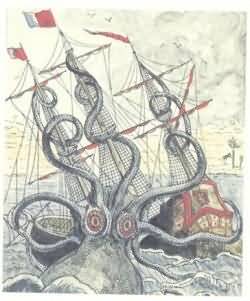
Can you imagine what a kraken could do to a Sunfish? Fortunately there are no reliable records of a kraken ever venturing into Barnegat Bay. But, as Ol' Charlie used to say, "that bay is full of strange critters."
Sunday, August 06, 2006
Kraken Alert
I warned you all about krakens, a month or so ago, and you skoffed. And yet, on a visit to the supermarket today, there was the Weekly World News proclaiming, "Giant Squid Attacks Jersey Shore!" and "Terror From Deep Unleashes Its Fury!" Still you may skoff, but the Weekly World News does not call itself "The World's Only Reliable Newspaper" for nothing.....
Sound Familiar?

Plane crash off Hyannis stuns beachgoers
Pilot swims away with no injuries after engine fails
By Maria Cramer, Globe Staff | August 6, 2006
Sandy Griffin was sitting comfortably in a small sailboat off Hyannis yesterday when she heard the sound of an engine sputtering.
She looked up to see a small red and white single-engine plane carrying an advertising banner descend rapidly toward the water.
The plane flew just a few feet over a man paddling in a kayak, she said, and according to police touched down on an isolated part of Kalmus Beach three times before it crashed nose first into the ocean, not far from hundreds of stunned beachgoers .
Griffin, a nurse's assistant from Falmouth, managed to take pictures as her 26-year-old daughter screamed and her 23-year-old son sat in stunned silence.
``It was nerve-racking," she said a few hours later yesterday, in a telephone interview. Minutes after the splashy nose dive , she saw a man furiously swimming away from the plane as rescue boats rushed to the scene.
The crash occurred shortly before 1 p.m. near the village of Hyannis. The pilot was the only person aboard and was not injured, according to Federal Aviation Administration spokeswoman Arlene Murray.
Barnstable Police identified the pilot as Matthew Benard, who is 27 and lives in Melrose. He has been a licensed pilot since 2001, said Barnstable sergeant Ben Baxter , who helped fish Benard out of the water.
``He was upset," Baxter said. ``He was full of adrenaline."
Benard was taken to Cape Cod Hospital as a precautionary measure and released, Baxter said .
Christy Mihos, the independent gubernatorial candidate, was on the deck of his Cape Cod home, about to bite into a roast beef and blue cheese sandwich when he saw the plane go into the water.
``My wife and I were watching," Mihos said. ``You could tell something was terribly wrong." He said the Hyannis harbormaster towed the plane to a sandbar.
``It's a miracle the way the thing went in [that] the pilot is OK," he said.
Mihos said he and his son rushed to their inflatable boat and sped off toward the accident to rescue the pilot. But the Coast Guard beat them to it, Mihos said in a phone interview.
Mihos, who stayed in the water for about an hour to make sure oil did not drip into the ocean, said he never got to finish his sandwich.
Thursday, August 03, 2006
Yachty Newport
Rosemary and I took a day trip to Newport last Saturday and happened upon the International Yacht Restoration School, a very cool 2 year program where one spends the first year restoring a beetle cat that anyone would think beyond repair let alone worthy of restoration. (The Beetle Cat is a 12 foot, gaff rigged, wooden sailboat first built in 1921 by the Beetle family of New Bedford, Massachusetts. Beetle, Inc., located in Wareham, Massachusetts, is now the sole builder of Beetle Cat boats.)
We were also able to peek in at the "Coronet", a 133-foot schooner yacht built in 1885, also being restored by students at the school.

We were also able to peek in at the "Coronet", a 133-foot schooner yacht built in 1885, also being restored by students at the school.
Windy Thursday
On Thursday, July 27, Dave and I decided to sail from Loveladies to the Surf City Yacht Club. As usual the wind was light as we left the dock. As it has been almost every day in the latter part of July, the wind was very strong once we got into the bay. Surf City beckoned several miles upwind so away we sailed. I think it took me about twenty tacks just to get past the Osprey nest and reach Harvey Cedars. But, it was exciting to be out there on a windy day and we continued on. Once we rounded the big island off of Harvey C. the bay opens up and the wind was stronger and the waves were bigger. The waves were big enough that it was crash and splash all the way. I was getting soaked and my gloves were just wet rags on my hands. I had to tack just about every minute because my hands and arms were too tired to hold the main sheet any longer. But turn back? Never! Actually I kept thinking about it but Dave was 20 boat lengths ahead of me and I couldn't shout loud enough for him to hear me and I didn't want to turn back without letting him know. We had to maintain diligent boat balance to keep from capsizing. I decided to sail closer to the shoreline where the waves were smaller. Dave went further out into the middle bay. The next time we crossed tacks he must have been fifty boat lenghts ahead. But, no matter what I wasn't going out into the middle of the bay beacause of the bigger waves and I didn't want to cross the boat channel. My arms were getting more tired and I couldn't sheet in all the way and so my tacks were not really getting me much upwind payoff. It was almost like I was just reaching back and forth and gaining about 100 feet each tack. Eventually I actually saw the goal line...the Surf City Yacht Club flagpole. Dave seemed to be almost there, about a mile ahead of me. Give up? No way. I think it took me about five hundred tacks to get to the club from Loveladies. But I got there. We sailed around the club and the members there looked at us and I wonder what they thought about these two guys in Sunfishes just out for a lovely day sail. Our sail downwind was about as fast as you can go in this boat with the wind behind you. The boats were about 2/3s out of the water. Off the wind my aching arms recovered pretty quickly. When we reached Maris Stella we turned in to wave to the sisters.
It was a week ago today. I wish that I could go out again.
It was a week ago today. I wish that I could go out again.
Monday, July 31, 2006

Wednesday, July 12, 2006
Kraken? We're not afraid of any krakens
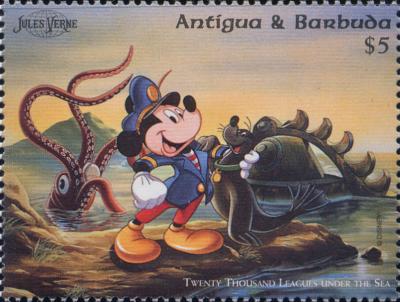
oh and stu got a new boom at the harvey cedars marina yesterday and the wind has diminished significantly so we are back in business!!!
Monday, July 10, 2006
Our Federal Tax Dollars at Work
A conversation between Linda and Stuart on the beach this afternoon began something like this: "I think there is a certain point at which the wind speed is too powerful for a sunfish, I'm not sure what that is though."
Today we found out what that is. Linda was literally flying across the bay, waves slamming over the side, thinking to herself, I wonder where Stu is. I hope he comes out soon, I wonder if he sees how fast I am going... Next thing I knew I looked over and saw Stu -- then saw him capsized. Tried to sail over to him downwind and then was going so f'in fast I had to undo the figure 8 knot in my mainsheet and just let it go. Cruised over to him using just the current to find out that his boom had snapped. Kind people on the nearby dock called the COAST GUARD who came by and towed him back home. oh and full disclosure mandates that i also was towed back to safety by a jetski.
Today we found out what that is. Linda was literally flying across the bay, waves slamming over the side, thinking to herself, I wonder where Stu is. I hope he comes out soon, I wonder if he sees how fast I am going... Next thing I knew I looked over and saw Stu -- then saw him capsized. Tried to sail over to him downwind and then was going so f'in fast I had to undo the figure 8 knot in my mainsheet and just let it go. Cruised over to him using just the current to find out that his boom had snapped. Kind people on the nearby dock called the COAST GUARD who came by and towed him back home. oh and full disclosure mandates that i also was towed back to safety by a jetski.
Saturday, July 01, 2006
Friday, June 23, 2006
Tuesday, June 20, 2006
Getting Ready for the Shore
We got the boats out this weekend. Of course, the closest that they got to the water is what came out of the garden hose - but at least they're shipshape!
Sunday, June 18, 2006
News from Columbus
it hasn't hit the news feeds yet, but i just got a call from my very good source at the episcopal convention that they elected a woman as presiding bishop.
Friday, June 16, 2006
If its all the same with you judge, I'll take the $30
T minus 30 days & counting until I'm sipping a Loveladies Daiquiri on the deck overlooking Little Egg Harbor.
Saturday, June 03, 2006
Friday, June 02, 2006
ursprache
Katharine Close, an 8th grader from Spring Lake, New Jersey spelled "ursprache" correctly to become the National Spelling Bee Champion. She is also reported to be a pretty good sailor.
Subscribe to:
Posts (Atom)